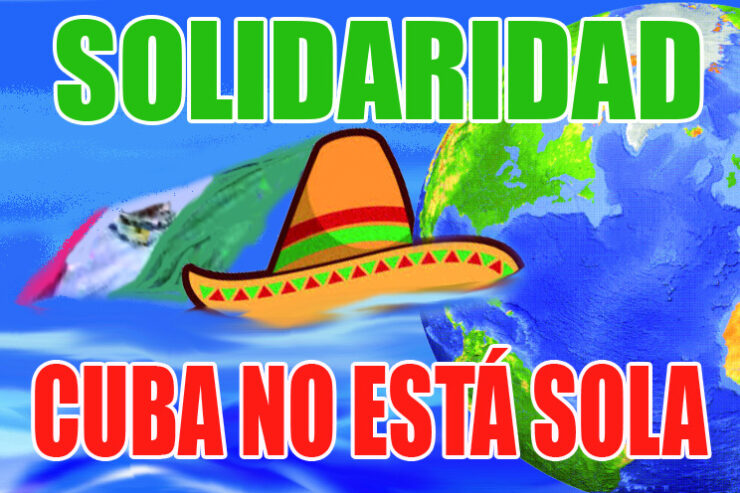
A second shipment of humanitarian aid for Cuba is being prepared in Mexico, following the arrival in Cuban territory of the logistical support ships Marina Papaloapan and Isla Holbox, carrying more than 800 tons of products.
Photo: Prensa Latina
A second shipment of humanitarian aid for Cuba is being prepared in Mexico, following the arrival in Cuban territory of the Papaloapan and Isla Holbox Navy support ships, carrying more than 800 tons of products.
“Once the first shipment arrives, the ship will return and a second shipment will be made, and so it will continue to be sent,” said President Claudia Sheinbaum at her morning conference on Wednesday.
In this regard, she added that mechanisms will be put in place to facilitate the participation of civil organizations that promote solidarity collections.
“I know that there are groups in society that are organizing to collect food supplies, and they can deliver them,” she said. In this regard, she instructed the Ministry of the Interior to act as a liaison in coordination with federal authorities regarding the space available on official shipments, where this aid would be added.
She noted that “there are organizations that are calling for this collection. We are not doing so yet because we are sending what we had, in addition to the support that is normally provided through Amexcid (Mexican Agency for International Development Cooperation).”
On the other hand, the president emphasized that Mexican flights to the island have not been suspended.
FROM PEOPLE TO PEOPLE
The campaign “From town to town, let’s end the blockade,” promoted by the Militant Solidarity Collective Va por Cuba and the Association of Cuban Residents in Mexico, will be held in the Zócalo from February 14 to 22.
The initiative will not only show, once again, that the Caribbean nation is not alone in its confrontation with the blockade, but will also serve to collect food and medicine to help alleviate the consequences of this genocidal policy.
In an official statement, both organizations assured that “the Mexican people—known for their solidarity, fraternity, and historic brotherhood with the Cuban people—are responding decisively to prevent the unjust punishment” of the Greater Antilles. They also stated: “What the blockade denies, solidarity delivers,” hence every product that arrives in Cuba “breaks the imperial siege.”
Díaz-Canel expressed the island’s high appreciation for the work of the Bureau of the United Nations Committee on the Exercise of the Inalienable Rights of the Palestinian People
The Cuban leader recalled that the island was among the co-founders of the Committee and emphasized the important role it plays within the UN. Photo: Estudios Revolución
The First Secretary of the Central Committee of the Party and President of the Republic, Miguel Díaz-Canel Bermúdez, reaffirmed Cuba’s high regard for the work of the United Nations Committee on the Exercise of the Inalienable Rights of the Palestinian People and its extensive work in support of this cause.
On Wednesday afternoon, at the Palace of the Revolution, the Head of State received a delegation from the Committee’s Bureau, which is on a working visit, and reiterated the feelings of Cuba and the Cuban people towards the Arab country. “We,” he said, “are a sister nation to Palestine.”
The president recalled that the island was among the co-founders of the Committee and emphasized the important role it plays within the United Nations and other organizations in addressing the Palestinian cause.
In thanking him for the reception, His Excellency Coly Seck, president of the Palestine Committee and permanent representative of the Republic of Senegal to the UN, highlighted the time that the Cuban president set aside for this meeting amid so many other commitments.
After introducing the members of the Committee’s Bureau accompanying him, Ambassador Seck explained that, as part of the United Nations General Assembly, it is composed of 25 members and 24 observers who “share the view that Palestine must be free, that Palestine must be a sovereign state,” objectives for which they work and develop a broad agenda both at the UN and within other multilateral organizations.
The meeting was attended by Political Bureau member Bruno Rodríguez Parrilla, Minister of Foreign Affairs; Emilio Lozada García, head of the International Relations Department of the Party Central Committee; Anayansi Rodríguez Camejo, Deputy Minister of Foreign Affairs; and other officials.
The Committee on the Exercise of the Inalienable Rights of the Palestinian People is a subsidiary body of the United Nations General Assembly, established in 1975, with the primary responsibility of mobilizing international support for a peaceful, just, and lasting solution to the Israeli-Palestinian conflict, based on the two-state solution, and whose central focus is the promotion of the Palestinian people’s right to self-determination, national independence, sovereignty, and the return of refugees.
Cuba, which has historically maintained an unwavering position in defense of and solidarity with the just cause of the Palestinian people, is a founding member and holds one of the vice-presidencies of the Committee, with a permanent commitment to contribute as much as possible to legitimate international efforts aimed at ending the genocide being committed against the Palestinian people.
In an article published in the newspaper Patria on March 23, 1894, José Martí expressed the essence of American society, fragments that are still relevant today
It is essential that our America knows the truth about the United States. Nor should its faults be exaggerated, out of a desire to deny it any virtue, nor should its faults be hidden or touted as virtues. There are no races: there are only different modifications of man, in the details of habit and form that do not change what is identical and essential, according to the conditions of climate and history in which he lives. It is men of prologue and superficiality—who have not sunk their arms into the human entrails, who do not see from an impartial height the nations boiling in the same furnace, who do not find in the egg and tissue of all of them the same permanent duel of constructive disinterest and iniquitous hatred— the entertainment of finding substantial variety between the selfish Saxon and the selfish Latin, the generous Saxon or the generous Latin, the bureaucratic Latin or the bureaucratic Saxon: Latins and Saxons are equally capable of virtues and defects. What varies is the peculiar consequence of the different historical grouping (…).
It is supine ignorance, and childish and punishable levity, to speak of the United States, and of the real or apparent conquests of one of its regions or group of regions, as of a total and equal nation, of unanimous freedom and definitive conquests: such a United States is an illusion, or a deception. From the caves of Dakota, and the nation that is rising there, barbaric and virile, there is a whole world to the cities of the East, sprawling, privileged, entrenched, sensual, unjust. There is a world, with its stone houses and stately freedom, from North Schenectady to the stilted and gloomy station in South Petersburg, from the clean and interested town in the North to the shop of idlers, sitting on a choir of barrels, in the angry, poverty-stricken, shabby, sour, gray towns of the South. What the honest man must observe is precisely that not only have the elements of diverse origin and tendency with which the United States was created failed to merge in three centuries of common life, or one of political occupation, but that the forced community exacerbates and accentuates their primary differences, and turns the unnatural federation into a harsh state of violent conquest. It is the work of petty people, and of incapable and gnawing envy, to pick holes in obvious greatness and deny it outright because of one or another blemish, or to stand in its way like a prophet of doom, like someone who removes a speck from the sun. But it does not augur, it certifies, that which observes how in the United States, instead of the causes of union being tightened, they are loosened; instead of solving the problems of humanity, they are reproduced; instead of amalgamating localities in national politics, they divide and embitter them; instead of strengthening democracy and saving it from the hatred and misery of monarchies, democracy is corrupted and diminished, and hatred and misery are reborn, threatening. And it is not those who remain silent who fail in their duty, but those who speak out. They fail in their duty as human beings to know the truth and spread it; they fail in their duty as good Americans, who see the glory and peace of the continent as secure only in the free and open development of its various natural entities; nor with his duty as a son of our America, so that through ignorance, or dazzlement, or impatience, the peoples of Spanish descent do not fall, at the counsel of the prim toga and fearful interest, into the immoral and enervating servitude of a damaged and alien civilization. It is necessary that the truth about the United States be known in our America.
We must detest evil, even if it is ours; and even if it is not. Good things should not be disliked simply because they are not ours. But it is an irrational and futile aspiration, a cowardly aspiration of second-rate and ineffective people, to achieve the stability of a foreign people by means other than those that led to security and order in the envied people: through their own efforts and through the adaptation of human freedom to the forms required by the particular constitution of the country. In some, excessive love for the North is the understandable and imprudent expression of a desire for progress so lively and fiery that it fails to see that ideas, like trees, must come from deep roots and be of kindred soil in order to take root and prosper, and that the newborn is not given the season of maturity because the mustache and sideburns of old age hang on its soft face: monsters are created in this way, not peoples: one must live on one’s own and sweat out the fever. In others, Yankee mania is the innocent fruit of one or another leap of pleasure, like someone who judges the bowels of a house, and the souls that pray or die in it, by the smile and luxury of the reception room, or by the champagne and carnations on the banquet table:– suffer; lack; work; love, and in vain; study, with courage and freedom; mourn with the poor; weep with the miserable; hate the brutality of wealth; live, in the palace and in the citadel, in the school hall and in the hallways, in the theater box, of jasper and gold, and in the wings, cold and bare: and thus one can opine, with glimpses of reason, on the authoritarian and greedy republic, and the growing sensuality, of the United States.
In others, weak posthumous followers of the literary dandyism of the Second Empire, or false skeptics under whose mask of indifference a heart of gold usually beats, the fashion is disdain, and more, for the native; and they see no greater elegance than to drink the foreigner’s pants and ideas and go through the world upright, like a pampered lapdog, with the pompom of its tail. In others, it is like a subtle aristocracy, with which, loving blondness in public as their own and natural, they try to conceal their mixed and humble origins, without seeing that it has always been a sign of bastardy among men to brand others with it, and there is no surer denunciation of a woman’s sin than to flaunt contempt for sinners. Whatever the cause—impatience with freedom or fear of it, moral laziness or laughable aristocracy, political idealism or newly arrived naivety—it is certain that it is advisable, and even urgent, to present our America with the whole American truth, both Saxon and Latin, so that excessive faith in the virtue of others does not weaken us, in our founding era, with unmotivated and disastrous distrust of our own. In a single war, the Civil War, which was more about the North and South disputing dominance in the republic than about abolishing slavery, the United States, the offspring of three centuries of republican practice in a country with less hostile elements than any other, lost more men than all the Spanish republics of America, with the same number of inhabitants, lost together in the naturally slow and, from Mexico to Chile, victorious work of bringing the new world to fruition, without any further impetus. and with the same number of inhabitants, have lost together all the Spanish republics of America, in the naturally slow work, and from Mexico to Chile victorious, of bringing to the surface of the new world, with no other impetus than the rhetorical apostolate of a glorious minority and the popular instinct, the remote peoples, of distant nuclei and adverse races, where Spanish rule left all the rage and hypocrisy of theocracy, and the apathy and suspicion of prolonged servitude. And it is only fair, and legitimate social science, to recognize that, in relation to the facilities of one and the obstacles of the other, the American character has declined since independence, and is today less human and virile, while the Hispanic American, by all accounts, is superior today, despite its confusion and fatigue, to what it was when it began to emerge from the revolted mass of opportunistic clergy, inept ideologues, and ignorant or savage Indians.
And to help raise awareness of the political reality in America, and to accompany or correct, with the calm force of fact, the unquestioning—and, when excessive, pernicious—praise of American political life and character, Patria is inaugurating, in today’s issue, a permanent section entitled “Notes on the United States,” where, strictly translated from the country’s leading newspapers, and without commentary or editorial changes, we will publish those events that reveal, not the crime or accidental fault—found in all possible peoples—in which only the petty spirit finds bait and contentment, but those qualities of constitution which, by their constancy and authority, demonstrate the two truths useful to our America: the crude, unequal, and decadent character of the United States – and the continued existence there of all the violence, discord, immorality, and disorder for which the Spanish American peoples are blamed.
Cuba condemns and denounces new escalation of U.S. economic blockade
Statement by the Revolutionary Government
Photo: Ricardo López Hevia
The Revolutionary Government condemns in the strongest terms the new escalation by the U.S. government against Cuba in its efforts to impose a total blockade on fuel supplies to our country.
The executive order issued by the U.S. President on January 29, 2026, declares a supposed national emergency, under which his government will be able to impose trade tariffs on imports of products from countries that supply oil to Cuba.
To justify such extreme action, the text of the order contains an extensive list of lies and defamatory accusations against Cuba. Among them is the absurd assertion that Cuba constitutes an “unusual and extraordinary threat” to the national security of the United States. The President himself and his government are aware that no one, or very few, can believe such mendacious arguments, but they do not care. Such is their contempt for the truth, public opinion, and government ethics when it comes to endorsing their aggression against Cuba.
With this decision, the United States government, through blackmail, threats, and direct coercion of third countries, is attempting to impose additional pressure on the economic suffocation measures that have been in place since Trump’s first term to prevent fuel from entering our country. It consolidates a dangerous way of conducting U.S. foreign policy by force and exercising its ambitions to guarantee its imperialist hegemony. As announced, that country claims the right to dictate to sovereign states which nations they can trade with and to which they can export their domestic products.
The executive order issued by the President of the United States therefore constitutes a flagrant violation of international law and also contravenes the Proclamation of Latin America and the Caribbean as a Zone of Peace. It confirms that it is the government of that country that is threatening the security, stability, and peace of the region and the world.
The government of the United States has reached this point after 67 years of failing to surrender and destroy a genuine and legitimate political and revolutionary process of full sovereignty, social justice, and the promotion of peace and solidarity with the rest of the world.
Cuba’s historical willingness to engage in serious, responsible dialogue with the United States government, based on international law, sovereign equality, mutual respect, reciprocal benefit, non-interference in internal affairs, and absolute respect for the independence and sovereignty of states, is widely documented.
As everyone knows, including the U.S. government itself, Cuba poses no threat whatsoever to the United States, its national interests, or the well-being of its citizens, who, moreover, have always been treated with respect and hospitality when their government has allowed them to visit the island. Cuba does not threaten or attack any country. It is not subject to sanctions by the international community. It is a peaceful, supportive, and cooperative country, willing to help and contribute to other States.
It is also a country of a brave and combative people. Imperialism is mistaken when it believes that economic pressure and the determination to cause suffering to millions of people will break their determination to defend national sovereignty and prevent Cuba from falling, once again, under US domination.
The international community faces the inescapable challenge of determining whether a crime of this nature could be a sign of things to come or whether sanity, solidarity, and the rejection of aggression, impunity, and abuse will prevail.
We will face this new attack with firmness, equanimity, and the certainty that reason is absolutely on our side. The decision is one: